Written 23 October 2026. Every Meta claim below links to the Meta Newsroom post it comes from, opened on that date.
Muse is not a Facebook search feature. It is Meta’s personal AI agent, launched on 8 September 2026, and it is only available in the US and Canada. The Facebook change that affects search is a different product, AI Mode, which answers questions from public posts, Groups and Reels. They reach a business through two different doors, and you prepare for each one differently.
What Meta has actually announced
“Muse” now covers five things. Most coverage blurs them.
| Name | What it is | Announced | Source |
|---|---|---|---|
| Muse Spark | Meta’s language model. Powers Meta AI | 8 April 2026 | Meta Newsroom |
| AI Mode on Facebook | A search tab that answers from public posts, Groups and Reels, using Meta AI | 15 June 2026 | Meta Newsroom |
| Muse (the agent) | A personal AI agent that takes actions for you | 8 September 2026 | Meta Newsroom |
| Muse for Small Business | The agent connected to business tools, Facebook Pages and Meta ad accounts | 29 September 2026 | Meta Newsroom |
| Muse Wonder | Larger models, to power Muse, subscribers first | 12 October 2026 | Meta Newsroom |
What Meta says the agent does, from its launch post:
- It runs on its own cloud computer, Muse Secure VM, which has its own browser.
- It can open a browser, fill in forms and negotiate for the user.
- It keeps working after the app is closed and asks for approval before sensitive steps such as sending an email or buying something.
- It pays through Link by Stripe, with Shop Pay announced as coming.
- Meta says Muse does not share conversations or VM data with its ad systems.
- It launched in the US on iOS, Android and muse.ai, free for most uses, with paid plans.
At Connect, Meta said Muse launched with access to the full Shopify catalogue and named new retail connectors including Walmart, Best Buy, Sephora and Wayfair. Muse is coming to Meta’s glasses “in the coming months”.
UK position. Meta’s small-business post says Muse is available in the US and Canada. None of the five Meta posts above gives a UK date. Meta’s AI Mode post gives no country list at all.
How Muse differs from Meta AI, AI Mode and other agents
| Meta AI | AI Mode on Facebook | Muse | |
|---|---|---|---|
| Job | Answers questions | Answers questions inside Facebook search | Does tasks |
| Main source | Web plus Meta’s apps | Public posts, Groups, Reels | The web, through its own browser, plus the apps you connect |
| Acts for you | Some planning and scheduling sinceJuly | No | Yes: forms, messages, purchases, with approvals |
| Where | Inside WhatsApp, Instagram, Facebook, Messenger | Facebook search bar | Muse app, WhatsApp, muse.ai |
Muse is closer to OpenAI’s and Google’s agents than to Facebook search. The difference is the starting point. Meta’s agent arrives already knowing what a user saved, liked and said across its apps. Meta’s own example: it can turn a recipe Reel saved on Instagram into a grocery list.
The two doors
This is the frame I’d use for everything that follows.
Door one: the social door. AI Mode and Meta AI answer from what people say publicly on Meta’s apps. Meta’s AI Mode post says answers are “grounded in what people are saying publicly”. Your website is not the main source here. Posts, Groups and Reels about you are. Meta’s Muse Spark post says answers will include Reels, photos and posts “with credit back to the content creators”. It does not promise a link to your site.
Door two: the web door. Muse and Meta AI’s research mode go out to the open web. Meta AI now synthesises research from across the web as well as from creators on its apps. Meta’s shopping mode searches Marketplace alongside options from across the internet. Here your website, your product data and whether a machine can read and use your pages decide whether you get picked.
The social door affects how people find you without a search engine. The web door affects whether an agent can do business with you once they have.
| Traditional search | Social discovery | AI answers | AI agents | |
|---|---|---|---|---|
| Example | Google results page | Facebook AI Mode, Groups | Meta AI, Google AI Mode, ChatGPT | Muse |
| What it reads | Indexed web pages | Public posts, Groups, Reels | Web pages plus its own platform’s content | The web through a browser, plus connected apps |
| What the user gets | A ranked list | A summary of what people say | One written answer | A finished task |
| Sends a click? | Usually | Rarely, as far as Meta has shown | Sometimes | Only if the task needs your site |
| What you control | Your pages | Your Page and posts; not what others say | Your pages, and which crawlers can read them | Whether your site can be used to finish the task |
| How you measure | Rankings, clicks | Manual checks | Manual checks, referrals | Conversions, if you can see them |
What this means for Google, organic SEO and traffic
Facts first, then my read.
Known. Facebook search now has an AI answer tab. Meta’s model is built to cite content from its own apps. Meta runs a crawler, meta-webindexer, that its crawler documentation says helps it “cite and link to your content in Meta AI’s responses”. So Meta is building a web index for answers, not just a social feed.
Not known. How AI Mode chooses which posts to use. Whether AI Mode answers link to websites. How often Muse uses a search engine, and which one. Meta has not published any of this.
My read. Nothing here changes how Google ranks pages, and I’d ignore anyone who says otherwise. What changes is how much of the journey happens before or instead of a Google search. A question like “who’s a good plumber near me” can now be answered from Group recommendations inside Facebook. A task like “rebook my dentist” can be done by an agent that never shows anyone a results page. Both take clicks out of the funnel that SEO has always measured.
The UK timing matters. In the UK today, door one is the live one. Door two is a North American story for now, unless you sell into the US or Canada.
Why posts, Groups and Reels now count as search inventory
AI Mode turns public Facebook content into the source material for answers. For a local business, a Group thread where three people recommend you is now something an AI can summarise. So is a thread where they complain.
Three things follow:
- What others say about you is the input. You don’t control it. You influence it by doing good work and by being present where those conversations happen.
- Your own Page and Reels are public content too. Plain, specific posts (what you do, where, prices, opening hours) give an answer engine something accurate to pull.
- Reliability is unresolved. TechCrunch noted that summarising everyday users’ posts rather than vetted sources risks outdated or misleading answers. If AI Mode says something wrong about you, the fix is in the source posts, not in your website.
How agents change the way customers choose a business
An agent shortlists, compares and acts. It does not browse ten tabs.
Two reported cases show the edges:
- Sites can say no. ABC News reported that Amazon denied Muse access to its site, with a pop-up saying unauthorised AI breaches Amazon’s conditions of use.
- Agents act on permissions, not judgement. AP, via Fortune, reported that Muse accepted a Marketplace offer and shared a seller’s home address because of an “always allow” permission he had granted. Meta acknowledged a separate pricing error.
Shoppers already let agents fill the basket but not pay. My read: agents favour businesses they can complete a task with. Muse launched with named commerce connectors and the Shopify catalogue. A business the agent can book, buy from or message cleanly has an edge over one it can only read. That edge shrinks as competitors connect too, and then price, stock and reviews decide it again. This is inference from Meta’s launch materials, not something Meta has stated about ranking.
The AI Discovery Stack
A framework for checking whether a business can be found, understood, chosen and credited by answer engines and agents. Six layers. Each depends on the one below it.
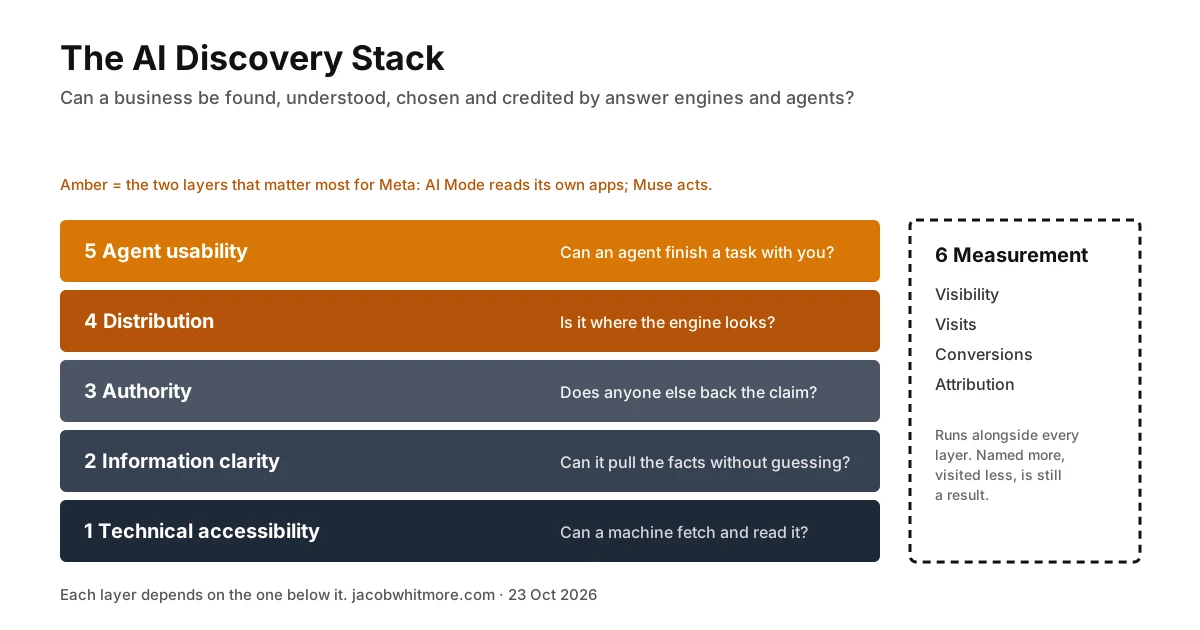
| Layer | Question | Fails when |
|---|---|---|
| 1. Technical accessibility | Can a machine fetch and read the page? | Content needs JavaScript to render, key facts sit in images, or robots.txt blocks the crawler you actually want |
| 2. Information clarity | Can it extract the facts without guessing? | Price, location, hours, specs and policies are vague, inconsistent or missing from the body text |
| 3. Authority | Does anyone else back the claim? | No reviews, no third-party mentions, no named author, no dates |
| 4. Distribution | Does it exist where the answer engine looks? | Absent from Facebook Groups, Reels, Marketplace, Merchant Center, Shopify catalogue or whichever source each engine draws from |
| 5. Agent usability | Can an agent finish a task with you? | Forms break, checkout blocks automation without saying so, booking needs a phone call, no clear contact route |
| 6. Measurement | Do you know it happened? | You count visits only, so answers that mention you and send no click are invisible |
Two layers carry most of the weight for Meta specifically. Distribution (layer 4), because AI Mode reads Meta’s own apps first. Agent usability (layer 5), because Muse acts rather than lists.
On layer 1, one point is easy to get wrong. Meta’s crawler documentation separates three AI crawlers:
| Token | Meta’s stated job | robots.txt |
|---|---|---|
| meta-externalagent | Training AI models, or improving products by indexing content directly | Meta’s own robots.txt example uses this token |
| meta-webindexer | Improving Meta AI search; allowing it helps Meta cite and link to you | Not stated |
| meta-externalfetcher | Fetching links a user asked for, for agentic features | Meta says it “may bypass robots.txt rules” |
Blocking the training crawler and blocking citation are separate decisions. My UK news crawler study found that on 2 October 2026, 7 of the UK’s 10 biggest newsbrands blocked Meta-ExternalAgent. That study did not test meta-webindexer or meta-externalfetcher, so I can’t say whether those sites can still be cited in Meta AI. That gap is the next thing to measure.
Measurement: four numbers, not one
| Stage | What it means | How to check it today |
|---|---|---|
| Visibility | You appear in an answer or a shortlist | Run your real customer questions through Facebook AI Mode and Meta AI on a fixed date. Record whether you’re named, linked or absent. Run each twice, because answers vary (why) |
| Visits | Someone clicks through | Referrals from facebook.com, l.facebook.com and meta.ai in analytics. I have not confirmed what referrer, if any, Muse’s browser sends |
| Conversions | A sale, booking or enquiry | Your normal conversion tracking, segmented by those referrers |
| Attribution | You can tie the conversion to the answer | Ask “how did you find us?” at booking or checkout, with “AI assistant” and “Facebook” as options |
The trap is reading falling visits as falling visibility. With answer engines, you can be named more and visited less. Track the first row separately or you’ll never see it.
AI Discovery Readiness Checklist
Technical accessibility – Key pages render their main content without JavaScript. – robots.txt decisions for meta-externalagent and meta-webindexer are made separately, on purpose. – Prices, hours and specs are text, not images.
Information clarity – Business name, address and phone match across site, Facebook Page and listings. – Prices, delivery costs and return terms are in the body text. Answer engines often drop schema and meta tags; body text survives. – Every page with a figure says when that figure is from.
Authority – Named author and date on advice pages. – Reviews on at least one public platform, recent ones included. – Third-party mentions you can point to.
Distribution – Facebook Page complete and posting plain, factual updates. – Present in the local or niche Groups where your customers ask for recommendations, as a participant, not an advertiser. – Products in Merchant Center, and in Shopify’s catalogue if you’re on Shopify.
Agent usability – A human can complete booking or checkout without a phone call. – If you block automated access, say so plainly on the page. – Contact details are text, not a form-only route.
Measurement – A dated monthly check of 10 real customer questions in AI Mode and Meta AI. – “AI assistant” added as a how-did-you-hear option.
What to do in the next 30 days
Week 1. Write down 10 questions real customers ask before buying. Run them through Facebook AI Mode and Meta AI. Record named, linked or absent, with the date.
Week 2. Fix layer 2. Make the facts an answer needs (price, location, hours, policy) consistent and in plain text on your site and your Facebook Page.
Week 3. Decide your Meta crawler policy token by token. If you block training, check you haven’t also blocked citation by accident.
Week 4. Try your own checkout or booking the way an agent would: start to finish, no phone call. Fix what breaks. Rerun the week 1 questions and compare.
If you sell into the US or Canada, add Muse to week 1. If you don’t, it can wait. AI Mode can’t.
The risks
- Zero-click by design. AI Mode answers inside Facebook. A good answer about you may send nobody to your site.
- Platform dependence. If distribution on Meta’s apps becomes your route to being found, Meta sets the rules and can change them. Your site is the only asset you control.
- Errors at the source. AI Mode summarises user posts. Wrong posts can make wrong answers.
- Agents act on permissions. The Marketplace case shows an agent doing what it was allowed to, not what its user expected. Businesses that deal with agents will see the same mistakes from the other side.
Known vs speculative
| Known (dated, sourced) | Speculative |
|---|---|
| Muse launched 8 Sep 2026; US and Canada only | When it reaches the UK |
| AI Mode answers from public posts, Groups and Reels | How it picks posts, and whether it links out |
| Meta runs a separate crawler for citing and linking in Meta AI | How much traffic Meta AI citations send |
| Meta’s agent fetcher may bypass robots.txt | How Muse’s own browser identifies itself |
| Amazon blocked Muse | Whether other big retailers follow |
What this can’t tell us
- Meta has not published how AI Mode or Muse rank anything.
- I have not used Muse. It isn’t available in the UK.
- This piece is a reading of Meta’s announcements and reported cases. The only original data is my 2 October crawler snapshot.
Called on 23 October 2026
P32. By 2 April 2027, Meta’s Web Crawlers page will not list a separate user-agent token for Muse’s own browser.
Right if: on 2 April 2027 the page names no token that mentions Muse or describes the Muse Secure VM browser. Wrong if: it does. Checked on 2 April 2027 either way. It’s on the board.
Method
The method is the same as every post here. Meta claims come from the Meta Newsroom posts linked, each opened on 23 October 2026. Crawler descriptions come from Meta’s developer documentation, opened the same day. Third-party reports (ABC News, AP via Fortune, TechCrunch) were opened on 23 October 2026 and are labelled as reports. The Meta-ExternalAgent figure comes from my 2 October 2026 snapshot of 10 UK newsbrands’ robots.txt files.
Sources
- Meta, Introducing Muse Spark, 8 April 2026 (updated 12 May)
- Meta, New AI Tools to Help You Make Things Happen on Facebook, 15 June 2026
- Meta, Meta AI Doesn’t Just Think, It Acts, 24 July 2026
- Meta, Introducing Muse, 8 September 2026
- Meta, The Biggest News From Connect 2026, 24 September 2026
- Meta, Muse for Small Business, 29 September 2026
- Meta, Introducing Muse Wonder, 12 October 2026
- Meta for Developers, Meta Web Crawlers
- TechCrunch, Meta’s new ‘AI Mode’ on Facebook, 15 June 2026
- ABC News, What to know about Meta’s Muse AI agent, 24 September 2026
- Fortune (AP), An AI agent sent a stranger to a man’s house, 19 October 2026
- Jacob Whitmore, Which UK news sites block GPTBot and other AI crawlers?
FAQ
Is Meta Muse available in the UK?
No. As of 23 October 2026, Meta says Muse is available in the US and Canada, and none of its posts gives a UK date.
Is Muse the same as Meta AI?
No. Meta AI is the assistant inside Meta’s apps and answers questions. Muse is a separate agent that carries out tasks. Both run on Meta’s Muse models.
What is AI Mode on Facebook?
A tab in Facebook search, launched 15 June 2026, that gives an AI answer built from public posts, Groups and Reels instead of a list of results.
Does Muse affect Google rankings?
There is no evidence it does. What it can change is how many people reach Google, or your site, at all.
Should I block Meta’s AI crawlers?
Decide token by token. meta-externalagent is for training. meta-webindexer is the one Meta says helps it cite and link to you. Blocking one is not blocking the other.
How do I know if Meta’s AI mentions my business?
Ask it. Run your customers’ real questions in AI Mode and Meta AI on a fixed date each month and record whether you’re named, linked or absent.