Checked 29 October 2026
None of the 32 AI search statistics repeated most across statistics roundups passes all five basic checks, and none of them is about the UK.
I took the statistics that appear on at least three of 20 roundup pages, found the document each one came from, and checked whether that document says when it was measured, how many were measured, where, how, and whether the data is published. Then I checked whether the roundups state the figure the way the source does.
The headline numbers
- 32 statistics appear on three or more of the 20 roundups.
- 28 traced to a source document I opened. 4 didn’t (see below).
- 0 pass all five checks. The best score is 4 of 5, reached by 8 statistics.
- 1 has raw data you can download: a 2023 academic paper.
- 0 of the 28 traced are about the UK. 10 are US (one of them US and EU), 9 are stated as global, and 9 don’t name a country.
- 11 are stated by every roundup the way the source states them. 16 are stated correctly by some roundups and changed by others. 1 is changed by all of them.
- 4 have been replaced by a newer figure from the same source, and roundups still print the old one.
- The median figure was measured 15 months before 29 October 2026 (26 statistics with a measurement period).
The five checks
- When: does the source give the measurement period?
- How many: does it give the sample size?
- Where: does it name the country?
- How: is the method published in full?
- Can you check it: is the raw data published?
They’re adapted from Five labels every AI visibility number needs. Those labels were written for prompt tests; most statistics in roundups aren’t prompt tests, so prompt and model became sample, country and method.
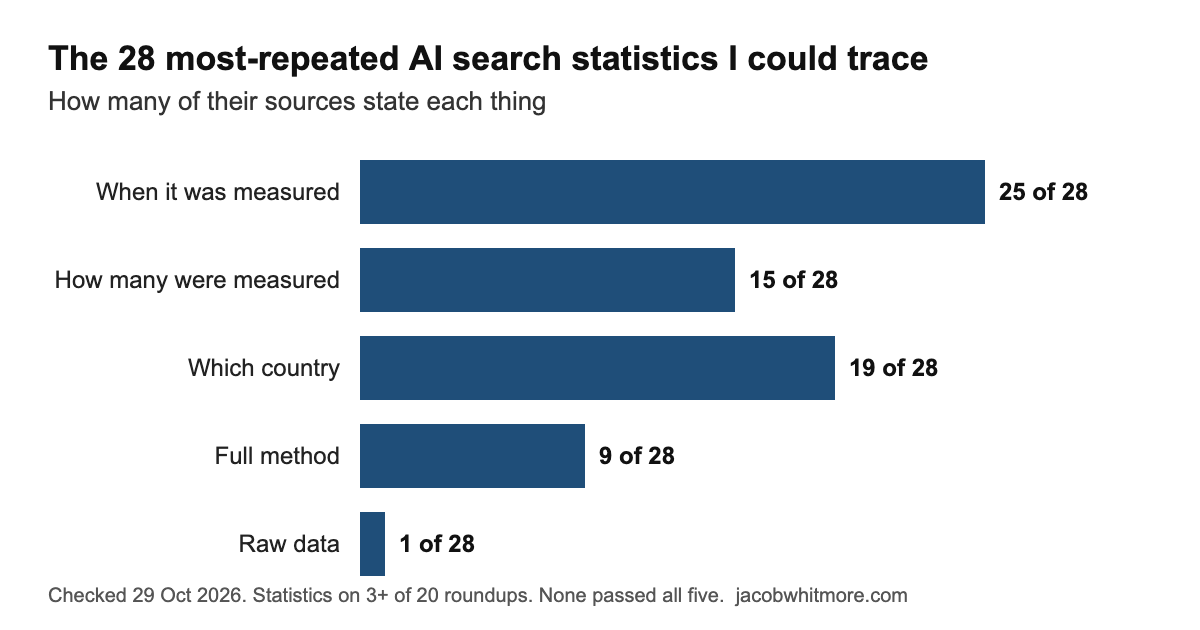
| Check | Passed | Of 28 traced |
|---|---|---|
| When | 25 | 28 |
| How many | 15 | 28 |
| Where | 19 | 28 |
| How (in full) | 9 | 28 |
| Raw data | 1 | 28 |
The ten most repeated
| Statistic as roundups repeat it | Roundups | Source | Measured | Checks | Roundups state it as the source does? |
|---|---|---|---|---|---|
| With an AI summary, 8% of visits click a result vs 15% without | 8 | Pew Research Center | March 2025, 900 US adults | 4 | Some don’t |
| AI Overviews cut position 1 CTR by 58% | 7 | Ahrefs | Dec 2023 vs Dec 2025, desktop | 2 | Some don’t |
| AI Mode has 1 billion+ monthly users | 7 | As of May 2026 | 2 | Yes | |
| ChatGPT has 900 million+ weekly users | 7 | OpenAI | As of Feb 2026, since replaced | 2 | Yes |
| Sessions end after 26% of AI-summary pages vs 16% | 6 | Pew | March 2025 | 4 | Some don’t |
| 1% of visits click a link inside the AI summary | 6 | Pew | March 2025 | 4 | Some don’t |
| AI Overviews cut position 1 CTR by 34.5% | 6 | Ahrefs | Mar 2024 vs Mar 2025, since replaced | 2 | Some don’t |
| Search volume will drop 25% by 2026 | 6 | Gartner (forecast) | Made Feb 2024 | Not traced | Not traced |
| ChatGPT messages: 49% asking, 40% doing, 11% expressing | 5 | OpenAI research paper | To July 2025 | 4 | Yes |
| About 60% of searches end without a click | 5 | Bain & Company | Not stated | 0 | Some don’t |
All 32 rows, with every link, the drift note and the coding, are in the CSV.
What roundups change
The figures are usually right. The context around them goes missing.
Pew’s numbers are about visits, not people
Pew tracked 900 US adults’ browsing in March 2025. Its 1% is visits to a page with an AI summary that included a click on a summary link. One roundup turns that into “1% of users”. Its 26% is the share of search pages after which the person left the browser for five seconds or more. Roundups turn that into “searches that stop completely” and “no site visit”.
Ahrefs’ 58% is a correlation against a forecast, on desktop
Ahrefs compares December 2023 with December 2025 across 300,000 keywords and says so. No roundup in the sample says it’s desktop-only, and several call it a measured cut.
Ahrefs replaced its own 34.5%
The April 2025 post now carries an editor’s note pointing to the 58% re-run. Six roundups still print 34.5%, and at least two give it as the current figure.
Semrush’s 4.4x has no working shown
Semrush says the average AI search visitor is worth 4.4 times an organic visitor, based on conversion rate. The page gives no conversion rates, no period, no sample and no country. It scores 0 of 5. Roundups say AI visitors “convert 4.4x better”.
Botify’s 47% is a ceiling from 2024
The source says AI Overviews appear for “up to 47%” of 120,000 searches, with no date or market on the page; press coverage dates it to August and September 2024. All three roundups that carry it state it as a current share of Google searches.
Semrush’s 2028 is a hedged projection
Semrush says digital marketing and SEO topics “may start” getting more visitors from AI search than traditional search by early 2028, and calls it an extrapolation. Roundups drop the “may” and the topic limit.
The GEO paper’s 40% was measured on a lab engine
Aggarwal et al. (2023) got about a 41% gain for one method on one visibility metric, using Google’s top five results summarised by GPT-3.5. It’s the only statistic in the sample with raw data, and it wasn’t measured on a live AI search product.
Replaced by their own source
| Still repeated | Replaced by |
|---|---|
| Ahrefs: 34.5% CTR drop (Mar 2025) | Ahrefs: 58% (Dec 2025), same method |
| SparkToro: 58.5% US zero-click (2024) | SparkToro: 68.01% (Jan–Apr 2026), different panel |
| OpenAI: 900 million weekly users (Feb 2026) | OpenAI: more than 1 billion people, no period given (Aug 2026) |
| Google: Gemini app 950 million monthly users (Q2 2026) | Google: more than 1 billion (Aug 2026) |
Four I couldn’t trace
- “Search volume will drop 25% by 2026” (Gartner). The press release exists but wouldn’t open from my research environment. It’s a forecast made in February 2024. I’ll check it in a browser and score it separately.
- “83% zero-click when an AI Overview shows.” Credited to Similarweb. Neither Similarweb page I opened contains it, nor does the page another roundup credits. I found no source.
- “ChatGPT has 1 billion weekly users” (August 2026). The OpenAI pages roundups link to wouldn’t open. The OpenAI page that did says more than 1 billion people, without “weekly”.
- “News zero-click rose from 56% to 69%” (Similarweb). The report is download-only. The figure appears in press coverage, not on any page I could open.
Who measured what
Of the 28 traced:
- 9 are vendor research (Ahrefs, Semrush, BrightEdge, Botify, Adobe, Bain).
- 8 are independent research (Pew, and SparkToro using Similarweb or Datos panel data).
- 6 are company statements from Google or OpenAI about their own products. These pass “when” and “where” and fail “how many”, “how” and “can you check it” by design: they’re self-reported counts with no published definition of a user.
- 3 are academic papers, 1 a forecast and 1 a survey.
Method
Six searches on 29 October 2026, first ten results each: AI search statistics, AI Overviews statistics, ChatGPT search statistics, AI SEO statistics, generative engine optimization statistics, zero-click search statistics. Every statistics roundup in those results, up to 21, was opened. Statistics were grouped when the same number described the same thing, and the 32 on three or more roundups were traced. A source counted only if I opened it; a roundup or news story quoting a figure didn’t count. Six of the 28 sources were opened a second time and reread as a check. Each CSV row carries the coding behind its checks. The rules every study here follows are on the method page.
Limits
- This checks whether a figure can be checked. It doesn’t say any figure is wrong.
- The sample comes from one US-based search tool on one day. A UK index or other queries would surface different roundups.
- Pages were read through a tool that summarises them. Six were reread independently and all six matched.
- “Some roundups state it differently” is a reading judgement. Every row in the CSV carries the note that explains it, so you can disagree with a specific call.
What happens next
I’ll rerun this on 29 January 2027 with the same six searches and the same five checks. Two calls go on the scoreboard today:
- P33: At least three of the four replaced figures above will still appear on three or more roundups on 29 January 2027.
- P34: None of the statistics on three or more roundups on 29 January 2027 will be measured in the UK.
Download
CSV: all 32 statistics, sources, checks and drift notes. One row per statistic; the five checks are explained above. Free to cite with a link.
Related: Five labels every AI visibility number needs · What I will not claim · How to write a claim you can mark wrong · Put the date in the same sentence as the figure · Do AI answers say when a “current” figure is from?
Sources
Each was opened on 29 October 2026.
- Pew Research Center: Google users are less likely to click on links when an AI summary appears
- Pew Research Center: What web browsing data tells us about how AI appears online
- Ahrefs: AI Overviews reduce clicks (34.5%)
- Ahrefs: Update: AI Overviews reduce clicks by 58%
- Google: I/O 2026 Search announcements
- Google: Sundar Pichai’s I/O 2026 keynote
- Google: Gemini app passes 1 billion monthly users
- OpenAI: How the world is putting ChatGPT to work
- Alphabet Q2 2026 earnings remarks
- OpenAI: Scaling AI for everyone
- OpenAI: How people are using ChatGPT
- OpenAI: New economic analysis
- Bain & Company: Goodbye clicks, hello AI
- SparkToro: In 2026, less than one third of Google searches still send a click
- SparkToro: 2024 zero-click search study
- Semrush: Google AI Mode’s early adoption and SEO impact
- Semrush: AI search SEO traffic study
- Semrush: AI Overviews study
- Adobe: 2025 holiday shopping season results (PDF)
- Aggarwal et al.: GEO: Generative Engine Optimization (arXiv)
- BrightEdge: AI Overviews at the one-year mark
- Botify and DemandSphere: AI Overviews report