
Written 16 November 2026. Opinion: this is my argument, not a study. Every figure links to where it came from.
Every November, businesses spend thousands chasing Black Friday traffic. I think many of them would be better off spending that money elsewhere.
Black Friday falls on 27 November this year. By now most marketing teams have a landing page, a discount code, an email sequence and an ad budget lined up for one weekend. Very few have asked whether the weekend pays them back once the discount, the ad costs and the customers who never return are counted.
My view is simple. For most businesses, Black Friday is a crowded auction for shoppers who are looking for a price, at the exact moment the way people find businesses is moving somewhere else. The time is better spent on the pages, data and reputation that get you recommended in March as well as November.
The short version
- The weekend is crowded and last year's payoff was thin. UK non-food retail sales grew 0.1% in November 2025, the month of Black Friday, according to the BRC.
- Shoppers are learning the deals aren't special. Which? found none of the Black Friday deals it tracked were at their lowest price of the year on the day itself.
- Search clicks are getting smaller. Pew found Google users clicked a normal result on 8% of visits when an AI summary appeared, against 15% without one.
- AI tools are becoming the shortlist. Adobe measured traffic from generative AI tools to US retail sites up 693.4% over the 2025 holiday season, from a small base.
- Discount-led customers are worth less. In one well-cited study, a 35% acquisition discount produced customers worth about half as much over time.
- Spend the budget on evergreen pages, original data and being easy for AI engines to read and cite.
Who I'm not talking to
If you're an established retailer with years of Black Friday data showing the weekend makes money after margin, returns and acquisition cost, keep doing it. Some categories really do move on Black Friday. In its November 2025 figures the BRC said computing and household appliances beat the previous year's Black Friday week, even though overall non-food growth was minimal (BRC).
This is for everyone else: the service business running a "Black Friday offer" because competitors are, the small shop discounting stock it would have sold anyway, the B2B firm sending a 30%-off email to a list that buys once a year. If you can't show the weekend paid for itself last year, you're chasing it out of habit.
Black Friday is a crowded room
Everyone turns up at once. That's the problem.
The UK data from last year isn't encouraging. Over the four weeks to 29 November 2025, total UK retail sales rose 1.4% year on year, and non-food sales rose 0.1%. Online non-food sales rose 0.5%. The BRC's chief executive, Helen Dickinson, said the month of Black Friday "did not deliver as strongly as retailers had hoped" (BRC, December 2025). The BRC put much of that down to nerves before the Budget, which is fair. It still means a lot of businesses spent a lot of money competing for a month that barely grew.
When demand is flat and every brand is shouting at once, the cost of being heard goes up. You're bidding for the same shoppers, on the same keywords, in the same inboxes, against companies with far bigger budgets.
Small businesses can't win a price war with Amazon
A small business entering Black Friday is entering a price war on the big retailers' terms. They have the buying power, the margin to absorb deep discounts and the brand recognition to win the click when a shopper sees two similar offers.
And shoppers are getting sceptical of the offers anyway. Which? tracked prices on 175 home, tech and health products at eight large UK retailers for a year around Black Friday 2024. It found 83% were the same price or cheaper at least once outside the four-week sales period, and none were at their cheapest of the year on Black Friday itself (Which?, 25 November 2025). Which? publishes some version of this every year, and the national press covers it every year.
So the biggest retailers are running discounts that often aren't the lowest price, and the public is being told so. A small business can't outspend that and can't out-discount it. It can be the business people trust when they're not in a hurry.
Seasonal SEO traffic flatters you
Black Friday keyword traffic looks great in a November report. Look at the other eleven months.
A page built around "black friday [product] deals" earns most of its visits in a few weeks. For the rest of the year it does almost nothing. If you judge it by its November peak, it looks like one of your best pages. If you judge it by what it earns per hour of work over twelve months, it usually isn't.
The visitors are also a particular kind of visitor. Someone searching for a Black Friday deal has told you what they care about: price, now. That's a fine customer to have if your margins can take it. It's a poor basis for a marketing plan.
Then there's the reporting trap. A spike in November makes the quarter look good, so the campaign gets repeated, so next November needs a bigger spike to look like growth. You end up running faster to stay in the same place.
AI search is changing how people find businesses
This is the part most Black Friday plans ignore.
For a long time the deal was simple. You ranked, people clicked, you sold. That deal is getting smaller. Pew Research tracked the browsing of 900 US adults in March 2025. When a Google results page showed an AI summary, users clicked a traditional result on 8% of visits. Without one, it was 15%. They clicked a link inside the summary on 1% of visits, and they ended their browsing session on 26% of visits with a summary against 16% without (Pew Research Center, 22 July 2025). I've written before that the future of search is a smaller click. This is what that looks like in practice.
At the same time, more of the shopping decision is happening inside AI tools before anyone reaches your site:
- Adobe measured traffic to US retail sites from generative AI tools up 693.4% over the 2025 holiday season (1 November to 31 December), and up 670% on Cyber Monday. Adobe itself says the base of users "remains modest" (Adobe, 7 January 2026).
- Adobe also reported that those AI referrals converted 31% better than other traffic sources over the season (Adobe blog, January 2026).
- On 24 November 2025, the Monday before Black Friday, OpenAI launched shopping research in ChatGPT. It asks what you need, reads product pages and reviews, and hands you a buyer's guide with its top picks (OpenAI).
- On 13 November 2025, Google added conversational shopping to AI Mode and the Gemini app, and started rolling out agentic checkout in the US, where you set a price and approve Google buying the item for you when it drops (Google).
Put those together. The shopper asks a question, the AI tool builds a shortlist, and the shopper clicks one or two names from it, often ready to buy. The fight is moving from "who ranks for black friday deals" to "who makes the shortlist".
Being the recommended brand is worth more than a seasonal keyword
A Black Friday landing page that goes live for three weeks gives an AI engine very little to work with. Shortlists are built from what's on the web: product pages, reviews, comparisons, guides, mentions on other sites. Most of that builds up over years, not over a weekend.
I can't show you a controlled test proving that steady, original content gets you cited more often. Nobody has published one. What the AI companies say they want is consistent, though. I went through what they publish in how ChatGPT, Claude, Gemini, Perplexity and Copilot choose their sources, and the argument for original research is in does publishing original research get you cited by AI?. Being crawled isn't the same as being cited, either. Crawled is not cited covers the difference.
There's also an opening here for smaller businesses that the Black Friday crowd hasn't noticed. When I checked the UK's ten most-visited retail sites on 12 November 2026, four blocked at least one AI crawler in robots.txt, and Amazon blocked 12 of the 15 I track (do the UK's biggest shopping sites block AI crawlers?). Amazon, eBay and Vinted also tell AI shopping agents to stay out of the checkout (will AI agents do your shopping?). If some of the biggest names are limiting what AI tools can read, a smaller site that's open, clear and current has more room to be the source.
That's the trade. A Black Friday campaign competes with Amazon on price for one weekend. Being the business an AI tool can read, understand and cite competes on usefulness all year.
Evergreen content keeps earning after the sale ends
Evergreen content is the page that answers a question people ask every month: which product suits which person, how to choose, what it costs to run, what goes wrong. It's the stuff a shopper, or an AI tool working for one, needs before they buy.
The economics are different. A Black Friday page has a short life and needs rebuilding every year. A good buying guide gets written once, updated when the facts change and keeps working. It can earn search traffic, AI citations, links from other sites and enquiries in the same month, and it does the same the next month.
It also suits how AI engines pick answers. They match a page to the person asking, so a page that says who it's for does better than one that says "great deals on everything" (write your customer into the page). They read what's in the body text, so the facts that matter should be there rather than tucked into schema or a banner (keep facts in body text).
Discounts attract the wrong customers
This is the cost most Black Friday reports leave out.
In a study in the Journal of Marketing Research, Michael Lewis looked at customer data from a newspaper and an online grocer. Deeper acquisition discounts went with lower repeat buying and lower customer value. In his example, a 35% acquisition discount produced customers with about half the long-term value of customers who joined at full price (Lewis, 2006). It's two businesses and it's twenty years old, so I wouldn't treat the exact ratio as a law. The direction is what matters, and it matches what most people who've run a discount see.
Here's how that plays out, as an illustration with invented numbers. Say a full-price customer is worth £200 to you over three years. Black Friday brings in 500 new customers at 35% off. If they behave like the customers in that study, each is worth about £100. The campaign report says "500 new customers". Measured against full-price customers, it's closer to 250.
The discount also teaches people when to buy. Train customers to wait for November and some of them will.
What I'd do with the Black Friday budget instead
Write the page your customers actually need
Pick the question your best customers ask before they buy and answer it properly. Who the product is for, who it isn't for, what it costs, how it compares. Put a date next to any figure that can change (put the date in the same sentence as the figure).
Publish something only you have
Your own data is the one thing a competitor can't copy and an AI engine can't get anywhere else. Prices you've tracked, jobs you've done, questions customers ask, results you've measured. Even a small, honest dataset gives people a reason to cite you.
Make sure AI tools can read your site
Check your robots.txt. Many small business sites have never decided whether AI crawlers can get in (small business sites aren't deciding at all). If you want to be found in AI search, let the search and retrieval crawlers in. The AI robots.txt generator will write the file for you.
If you do run an offer, keep it on a page that lasts
If you still want a Black Friday offer, run one honest offer on a page you keep year round, rather than a new campaign URL every November. The page keeps whatever links and history it earns, and you're not starting from zero each year.
How to measure growth, not a spike
A November traffic chart is the wrong scoreboard. These are better ones:
- Compare like with like. January this year against January last year tells you more about growth than November against October.
- Follow the cohort. Of the customers who joined over Black Friday, how many bought again within 90 days, compared with customers who joined in a normal month?
- Watch branded search. More people searching for your name is a sign the brand is growing, whatever the season.
- Check whether AI tools mention you. Ask ChatGPT, Gemini, Perplexity and Google's AI Mode the questions your customers ask, and run each one several times, because answers change (how many times should you run an AI prompt?).
- Read your AI reporting carefully. Search Console's AI report shows impressions, not clicks (what it can and can't tell you).
What this can't tell you
The AI traffic figures here are from the US. Adobe's data covers US retail sites and Pew's panel is US adults. I haven't found a comparable UK figure. The Which? price tracking covers home, tech and health appliances at big retailers, not every category. And the Lewis study is one strong piece of evidence on discounts. It doesn't settle the question on its own. Your own numbers should decide this. If you have them, use them. If you don't, that's the first thing to fix.
Stop chasing the weekend
Black Friday will keep working for some businesses. For most, it's a habit that costs margin, attracts deal-hunters and builds nothing that lasts past December. The shift to AI search makes that worse, because the shortlist gets built from everything you've published all year. One weekend of shouting doesn't change it much.
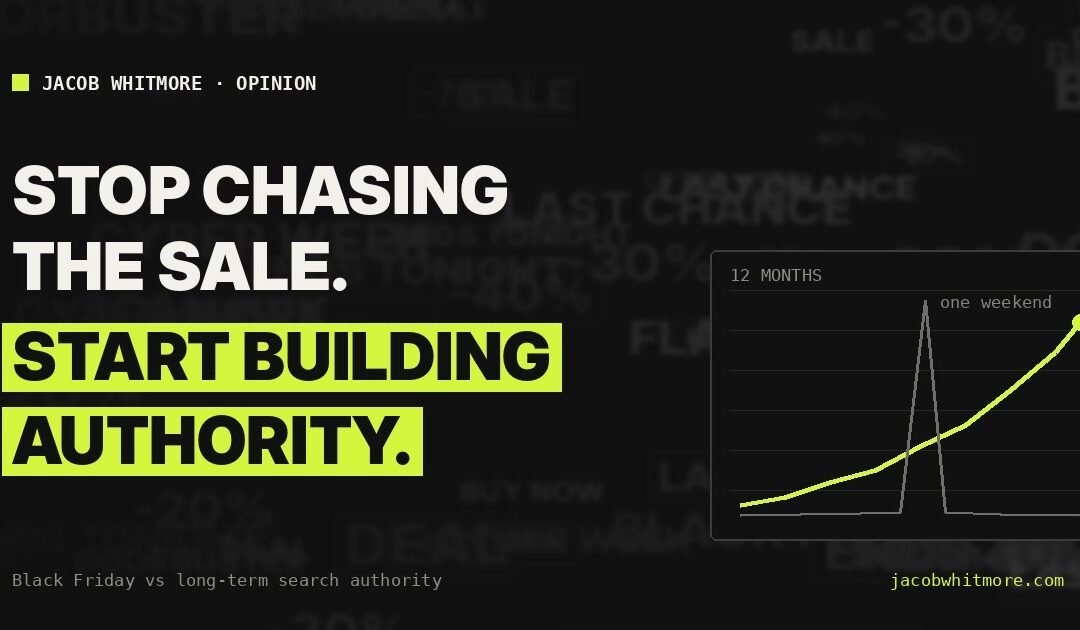
Stop chasing the weekend. Start building the authority.
Sources
- British Retail Consortium, BRC-KPMG retail sales monitor, November 2025. Opened 16 November 2026.
- Which?, Most Black Friday deals the same price or cheaper at other times of the year, 25 November 2025. Opened 16 November 2026.
- Pew Research Center, Google users are less likely to click on links when an AI summary appears in the results, 22 July 2025. Opened 16 November 2026.
- Adobe, Holiday shopping season drove a record $257.8 billion online, 7 January 2026. Opened 16 November 2026.
- Adobe, AI-driven traffic surges across industries, January 2026. Opened 16 November 2026.
- OpenAI, Introducing shopping research in ChatGPT, 24 November 2025. Opened 16 November 2026.
- Google, Let AI do the hard parts of your holiday shopping, 13 November 2025. Opened 16 November 2026.
- Lewis, M. (2006) 'Customer acquisition promotions and customer asset value', Journal of Marketing Research, 43(2), 195–203. Abstract opened 16 November 2026.
Cite this post
Whitmore, J. (2026) 'Black Friday Is a Waste of Time for Most Businesses. Here's Why I'd Stop Chasing It.', jacobwhitmore.com, 16 November. Available at: https://jacobwhitmore.com/black-friday-waste-of-time/
Free to quote with a link back.