
Opinion. Written 26 November 2026. The argument is mine; every figure links to a source I opened that day.
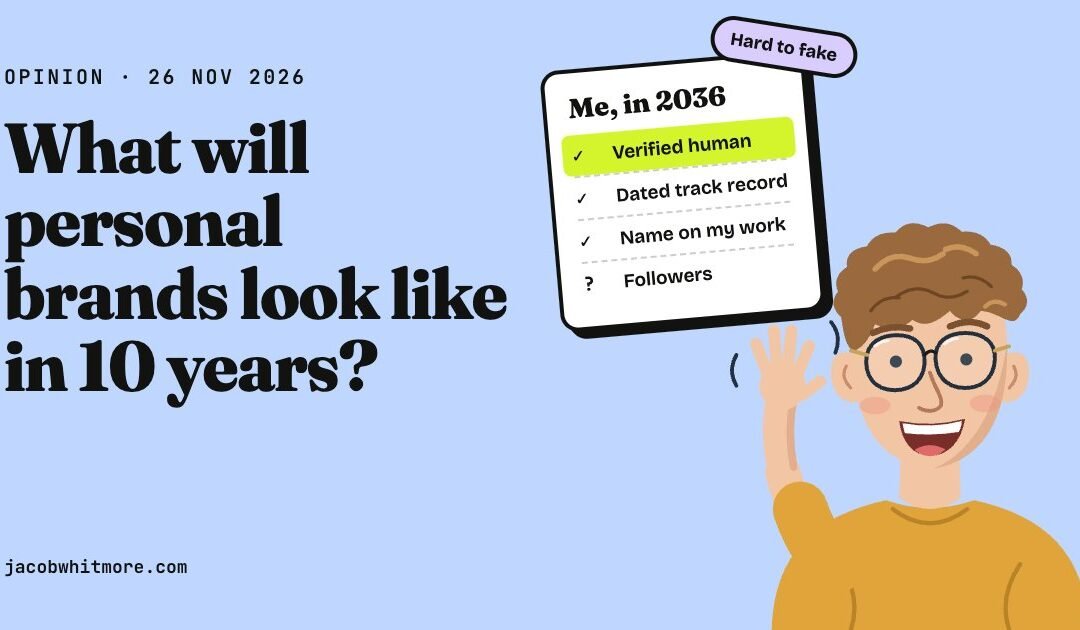
In ten years, a personal brand will be worth less as a following and more as a record. When anyone can fake your face, your voice and a thousand posts in your style, the thing that's hard to fake is a long, dated history of work with your name on it that people can check. That's my reading of where deepfakes, AI answers and trust are heading. It's a ten-year guess, so most of it can't be proved yet. At the end there's a smaller call I can check next year.
In plain English
A personal brand is what people think of when they hear your name: what you know, what you've done, and whether they trust you. For most people it lives on LinkedIn, a website, or in the way clients talk about them.
Two things are changing it. AI can now copy anyone's face, voice and writing style. And more people ask an AI "who should I use?" instead of searching and reading. This post says that in ten years the people who do well will be the ones with a real, checkable history of work under their own name.
What's already changing
Copying a person is now cheap. In June 2024, Ofcom found that 43% of UK people aged 16 and over said they'd seen at least one deepfake online in the past six months. Fewer than one in ten (9%) were confident they could spot one. Ofcom lists fake adverts and romance scams that borrow someone else's identity as one of the main harms (Ofcom, 23 Jul 2024).
The law is starting to ask for labels. Under Article 50 of the EU AI Act, people must be told when they're talking to an AI or looking at AI-made content, and deepfakes have to be disclosed. Those rules have applied since 2 August 2026, with extra time to 2 December 2026 for some machine-readable marking (artificialintelligenceact.eu, 14 May 2026). That's the EU, not the UK, but anyone selling into Europe will meet it.
Trust is shrinking to smaller circles. The 2026 Edelman Trust Barometer found seven in ten people are unwilling or hesitant to trust someone with different values, backgrounds or information sources. In the UK it was 76%. "My employer" was the most trusted institution, at 78% among employees (Edelman, 18 Jan 2026).
And search engines want to know who wrote things. Google's guide to helpful content asks whether it's obvious who wrote a page, whether there's a byline, and whether that byline leads to more about the author. It also warns against made-up authors (Google Search Central, read 26 Nov 2026).
The money is real, but thin at the top
People who sell on their own name are a big market. In April 2023 Goldman Sachs Research put the creator economy at $250 billion and estimated it could reach $480 billion by 2027. It counted about 50 million creators worldwide, and only about 4% of them earned more than $100,000 a year. Brand deals were about 70% of creator income (Goldman Sachs, 19 Apr 2023).
That's a forecast from a bank, three years old, and it measures influencers more than it measures the accountant or plumber whose name is their business. I use it for one point: a lot of people already earn from being known, and very few earn much.
My guess for 2036
Your face stops being proof
If a video of you can be made in a minute, a video of you proves nothing. I think the people who matter will carry some kind of proof that a post, a voice note or a video really came from them, and audiences will learn to ignore anything that doesn't. Labelling rules like the EU's are the first step.
The track record becomes the brand
An AI can write a thousand posts that sound like you. It can't go back and make you right in 2026 about something that happened in 2028. A dated archive of what you said, what you did and how it turned out gets more valuable every year, because it can only be built slowly. That's why this site dates every claim and keeps the misses.
AI assistants become the first reference
When someone asks an assistant who to hire for a loft conversion or who to read on pensions, the answer is built from what's written about you, under your name, in places it can read. If your work is scattered, unsigned or locked away, you're hard to recommend. I've written about how this already works for businesses in why top 10 lists matter so much for brands now.
Smaller and more local wins
If people trust fewer, closer sources, then being well known to the right thousand people beats being vaguely known to a million. The Edelman figures point that way. I'd expect more personal brands built inside an industry, a town or an employer, and fewer built on reach alone.
Put together: the follower count matters less, the paper trail matters more. That's the same argument I made about blogs in Will blogs still matter for SEO when AI answers first? The machine can summarise what's out there. It can't have done your work or put its name to your calls.
What I'd do with a personal brand today
- Have one home on the web that you control, under your own name, with a clear page about who you are.
- Put your name and the date on everything you publish.
- Make some claims that could turn out wrong, write down when you made them, and go back to mark them.
- Tell people where your real accounts are, so a fake one stands out.
- Spend less effort on reach and more on the people who actually hire you.
P44: AI assistants name people who have their own website
The 2036 picture can't be checked for ten years. One part of it can be checked now. If AI assistants build their recommendations from what's written under a person's name, the people they name should mostly have a home on the web of their own. Here's that as a call I can be marked on.
- Claim: When ChatGPT, Gemini and Perplexity are asked the 10 questions below, more than half of the distinct people they name will have a personal website, meaning a site they run under their own name that comes up first on google.co.uk when you search their name.
- Called: 26 November 2026.
- Check date: 26 May 2027.
- Test: Ask each assistant all 10 questions in a new chat, logged in on the free plan, from the UK, on one day. List every person named, once each. Search each name on google.co.uk, desktop, logged out, and record whether the first result is a site that person runs (their own domain, or a personal site they clearly control). LinkedIn, Wikipedia, an employer's staff page and social profiles don't count.
- Right if: more than 50% of the distinct people named have a personal website as defined above.
- Wrong if: 50% or fewer do, or the check isn't run and published by the check date.
- Inconclusive if: the three assistants name fewer than 20 distinct people between them, or one of them is no longer available in the UK.
- Baseline: not measured yet. I haven't asked these questions.
The 10 questions, fixed on 26 November 2026
Each one is asked as: "Who are good UK experts to follow on [topic]? Please name individual people."
personal finance · gardening · running · home energy and heat pumps · SEO · parenting · cooking on a budget · cycling · small business tax · photography
This goes on the prediction ledger with these dates. If I'm wrong, it stays there, marked wrong.
What I won't claim
- That I know what 2036 looks like. This is a guess built on 2024 to 2026 data.
- That personal brands are dying. The Goldman Sachs forecast has more people earning from their name, not fewer.
- That verification tools will work, or that one standard will win. I don't know which, if any, will.
- That having a website makes an AI recommend you. P44 tests whether the people named tend to have one, which isn't the same thing.
- Any UK figure for how many people earn from a personal brand. I haven't found one I trust.
Questions people ask
Will personal brands still matter with AI?
I think more, not less. When AI can copy anyone's style, a checkable history of real work under your own name is harder to fake than ever.
Can someone deepfake my personal brand?
They can fake your face and voice. Ofcom found 43% of UK people aged 16+ said they'd seen a deepfake in six months, and only 9% were confident they could spot one. It's much harder to fake years of dated work.
Do I need my own website for a personal brand?
I'd say yes. Google's guidance asks for clear bylines that lead to more about the author, and a site you control is the easiest place to show that.
Sources
All opened 26 November 2026.
- Ofcom, A deep dive into deepfakes that demean, defraud and disinform, 23 Jul 2024: ofcom.org.uk
- artificialintelligenceact.eu, The EU AI Act's Transparency Rules: A Practical Guide to Article 50, 14 May 2026: artificialintelligenceact.eu
- Edelman, 2026 Edelman Trust Barometer Reveals Trust is In Peril As Society Slides from Grievance into Insularity, 18 Jan 2026: edelman.com
- Google Search Central, Creating helpful, reliable, people-first content: developers.google.com
- Goldman Sachs, The creator economy could approach half-a-trillion dollars by 2027, 19 Apr 2023: goldmansachs.com
Related on this site: Will blogs still matter for SEO when AI answers first? · Why do top 10 lists matter so much for brands now? · Check what ChatGPT says about your business
Part of the topic How AI picks who to recommend, which lists every post on it. New to the jargon? AI search words, explained.