
Sources checked 26 November 2026.
When someone asks ChatGPT or Google “what’s the best CRM?” or “best running shoes?”, the answer is often built from top 10 lists other websites have written. So the lists your brand appears on, and where you sit in them, now shape whether an AI names you. Four studies published between December 2025 and July 2026 agree on that much. They also agree on the catch: a list you write about yourself does much less than a list someone else writes about you, and it can help your competitors instead.
That’s my reading of four studies (summarised from their own pages, not new data of mine). None of them is a controlled test, and none is about the UK.
What a “top 10 list” means here
A page that ranks options in a category: “The 12 best project management tools”, “Best SEO agencies in London”. Comparison sites like G2 or Clutch count too. In the industry these are called listicles. A “self-promotional” listicle is one where the company writing the list ranks itself, usually first.
Lists are what AI reads before it recommends
Ahrefs looked at ChatGPT’s sources for 750 “best X” questions about software, products and agencies. “Best X” blog lists were the most common type of page it used, at 43.8% of all source pages. Brands placed higher on those lists were more likely to be the ones ChatGPT recommended, though Ahrefs says that’s a correlation with some bias in it, not proof. The same lists were slightly more prominent still in Google’s AI Overviews (Ahrefs, 4 Dec 2025).
Freshness mattered. Of 1,100 cited lists with a clear date, 79.1% had been published or updated in 2025. Quality didn’t always: 35% of a sample of 3,000 cited lists sat on low-authority websites, many of which Ahrefs calls “highly questionable”.
The reason is simple. “Which is best?” has no official answer, so an AI does what a person would: it looks at who has already ranked the options. I made a similar point about local trades in October. Ask AI for “the best” plumber and you get a guess, built from whatever has been written about plumbers.
Your own list can work for someone else
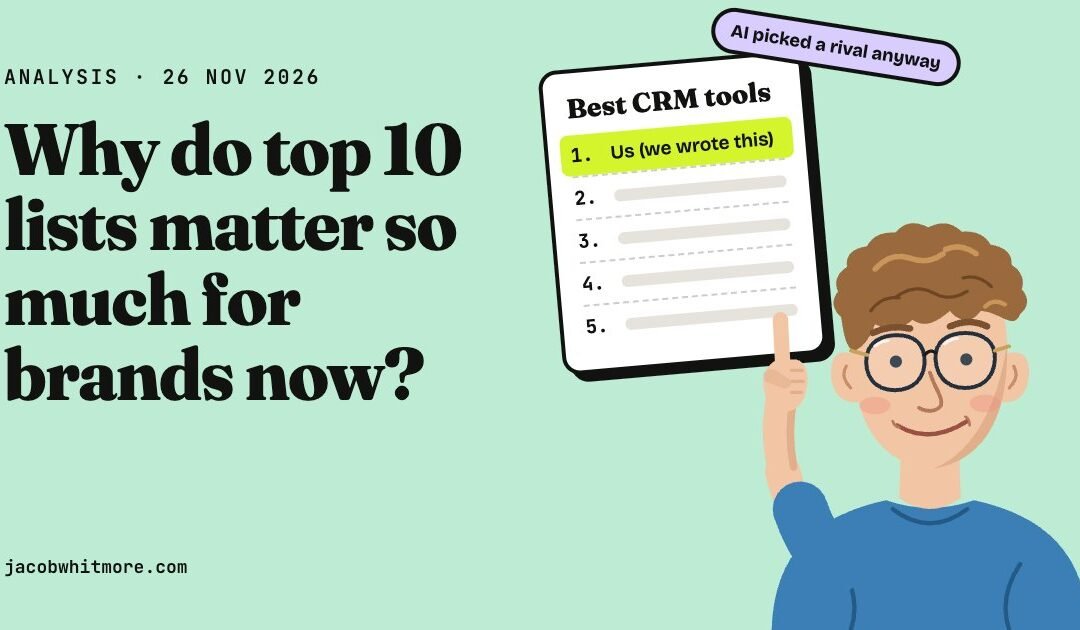
Many brands have spotted this and written their own lists with themselves at number one. Ahrefs found that in 169 of 250 Google results pages for “best X software” searches (67.6%), at least one list was written by a company that ranked itself first.
The evidence since says this works far less well than it looks.
Lily Ray checked 100 B2B “best [category] software” searches in Google’s AI Overviews on three dates between 15 April and 8 June 2026. When a brand’s own self-ranking list was cited as a source, that brand was left out of the actual recommendation 69% of the time (224 of 323 cited lists). The brands that did get recommended were the established names: the ones that appear on lots of other people’s lists and have plenty of links from elsewhere. Her examples include lists that named well-known competitors lower down. Google cited the list, then recommended the competitors (Lily Ray, 17 Jun 2026).
Ahrefs then ran its own test. It published 34 self-promotional pages about two of its products and tracked 9,886 answers from ChatGPT, Gemini, Perplexity and Copilot between February and May 2026 (Ahrefs, 6 Jul 2026).
- For a brand-new conference, the pages helped. It appeared in 72 answers that hadn’t named it before, and 82% of those cited one of Ahrefs’s pages.
- For an established product, they barely mattered. Only 6% of its new mentions came from answers citing Ahrefs’s own pages. The other 94% came from what other sites had written.
- When an AI cited one of the conference pages, 43% of those answers still didn’t mention the conference. They recommended a rival from the same page.
- Citations didn’t stick. Between a page’s first and last citation, it was cited on about one in three days.
Ahrefs’s own conclusion: this kind of page helps most when your brand is already a believable answer and the AI just hasn’t connected you to the category yet.
The window may be closing
Seer Interactive tracked over 2 million ChatGPT citations on the same set of questions from November 2025 to February 2026. Pages with “best” or “top” in the address made up 16.6% of citations over the period, falling from 17.8% in November to 15.5% in January. From December to January, those citations fell 30%, faster than citations overall (down 22.7%). Wikipedia and Reddit gained most of the share. Google’s AI Overviews went the other way on the same questions, flat or rising (Seer, 25 Feb 2026).
Lily Ray also reports that sites with hundreds of self-ranking lists started losing Google traffic from around 20 January 2026. That’s her analysis of over 40 sites, not something Google has confirmed.
One warning on the numbers. Ahrefs’s 43.8% and Seer’s 16.6% are not measuring the same thing. Ahrefs used only “best X” questions and classified pages by hand and with AI. Seer used a wider mix of questions and counted any address containing “best” or “top”. Neither figure means much without knowing what was counted.
What this means for a brand
My reading of the four together:
- Other people’s lists are the ones that count. Getting onto independent top 10 lists, review sites and comparison pages in your category, and moving up them, is what lines up with being recommended. That’s old-fashioned PR and reputation work, with a new reason to do it.
- Your own list is a weak signal and can be a gift to competitors. It may help a new or little-known brand in a narrow category get noticed. For everyone else, the evidence says the AI uses it as a source and recommends whoever else is on it.
- Lists go stale fast. The lists AI cited were mostly recent. If a list you’re on hasn’t been updated this year, it may already be dropping out.
- A citation isn’t a recommendation. Being linked as a source and being named as the answer are different results. Measure the second.
What I’m not claiming
- That any of these studies proves cause. All four watched outputs. None controlled for everything else that makes a brand well known.
- That they apply to the UK. They’re mostly US, English-language and weighted to B2B software. I found no UK study.
- That the percentages are stable. Ahrefs found AI citations flicker from day to day, and Seer saw shares move within a month.
- That the companies behind these studies are neutral. Ahrefs sells an AI visibility tool, Brand Radar, which it used for both of its studies and for Lily Ray’s data. Seer is an agency. That doesn’t make the findings wrong, but it’s worth knowing.
- That ChatGPT, Google or anyone else has said lists matter. None of them documents how they choose sources. See what the five companies actually say.
Frequently asked questions
Why do AI tools use top 10 lists?
For “best X” questions there’s no official ranking to check, so they lean on pages that have already ranked the options. In Ahrefs’s study of 750 such questions, “best X” lists were 43.8% of ChatGPT’s source pages.
Should my business write its own “best X” list?
Only if you’d be happy for a customer to read it. The evidence says self-ranking lists are often cited without the author being recommended (69% of the time in Lily Ray’s AI Overviews study), and Google appears to have turned against sites that publish them at scale.
How do I get on other people’s lists?
The same way as before AI: be good at something specific, be easy to compare (clear pricing, features, reviews), and be known to the people who write those lists. Ahrefs says its own focus is product updates, original research and being active where its audience is.
Does being cited mean AI recommends me?
No. In Ahrefs’s test, 43% of answers that cited its conference page recommended a different conference.
Sources
All opened 26 November 2026.
- Ahrefs, Glen Allsopp, Do self-promotional “best” lists boost ChatGPT visibility? Study of 26,283 source URLs, 4 Dec 2025
- Seer Interactive, Nick Haigler, The listicle window is closing in AI search: 30% decline MoM, 25 Feb 2026
- Lily Ray, Why calling yourself the “best” could be helping your competitors win in AI search, 17 Jun 2026
- Ahrefs, Mateusz Makosiewicz, Self-promotional content works, until it backfires (AI SEO experiment), 6 Jul 2026